Interviews
#10QuestionswithMaxwell Interview Series: Min Kyung Kim, Des Voeux Chambers
In this #10QuestionsWithMaxwell interview, we feature Min Kyung Kim, Neutral at Des Voeux Chambers and an adjunct professor at the City University of Hong Kong. She served as a judge in the Korean Judiciary from 2010 to 2025, with her expertise in international commercial matters. She sat in the International Commercial Division at the Seoul Central Court and has authored Overriding Mandatory Rules in International Commercial Disputes (Hart Publishing, 2025) which has been cited in the Hong Kong High Court in Xu Peixin v Fruitful Worldwide Limited [2025] HKCFI 5846.
Her earlier book in Korean language, Overriding Mandatory Rules and International Contracts (Pakyoungsa, 2022), earned her the 16th Shimdang Law Prize in 2023 which is the most prestigious award in the field of international commercial/business law in Korea. She has also published widely in leading journals and is a regular speaker at international conferences.
Dr. Kim participated in the recent amendment of the Korean Arbitration Act. She is a co-author of the Korean judiciary’s Practice Guide on Arbitration-related Cases (2018) and Commentary on the Korean Arbitration Act (Thomson Reuters, forthcoming in 2026). She is a delegation member of the Korean Judiciary to the Standing International Forum of Commercial Courts (SIFoCC).
She has taught courses on international commercial arbitration and litigation at the City University of Hong Kong, University of Hong Kong, National University of Singapore, and Singapore Management University. She holds a BA, MA and PhD from Seoul National University, and an LLM from the University of Cambridge (Queens’ College).
Read the full interview below:
Q: What initially drew you to dispute resolution, and what helped you decide to specialize in international arbitration?
What has always drawn me to dispute resolution is the opportunity to engage with and solve real-world problems. After completing my two-year training at the Korean Judicial Research and Training Institute, I was fortunate enough to have three career paths: judge, prosecutor, or attorney. I chose to become a judge because I found the role most compelling; by having an opportunity to assess the strengths and weaknesses of arguments to reach a conclusion and by rendering an immediately enforceable judgment, you provide a definitive solution to a dispute.
Another appealing aspect of dispute resolution is that no two disputes are the same, which ensures the work is never boring. During my years in the Korean judiciary, I heard a broad range of civil, commercial, criminal, and administrative cases, authoring more than 3,000 decisions with each case presenting unique issues of law and fact.
My path to specialising in international arbitration began somewhat by chance. In 2010, I was appointed as a judge in the International Commercial Division of the Seoul Central Court, the largest and busiest court in the nation. This assignment gave me the opportunity to handle numerous high-profile commercial cases with cross-border elements, including many arbitration-related matters.
My duties included ruling on the enforcement and annulment of arbitral awards and I found the issues complex and fascinating. I then began studying international arbitration in my spare time which led me to write my master’s thesis on the annulment of arbitral awards – comparing Korean and English law and practice. This academic work, in turn, opened the door to more practical opportunities. I joined various arbitration-related working groups at the Supreme Court of Korea. From there, one thing led to another: I became involved in amending the Korean Arbitration Act, was invited to co-author the Korean judiciary’s Practice Guide on Arbitration-Related Cases (2018), and contributed to the adoption of new Court Procedural Rules for these cases.
Q: From a judicial role to acting as a neutral, what aspects of decision-making did you find most rewarding to carry forward, and what required a conscious shift in mindset?
Two rewarding aspects of judicial decision-making have been particularly valuable to carry forward into my work as a neutral. First, the most rewarding aspect of the role is solving problems and providing the parties with the best possible resolution. Whether in litigation or arbitration, the core principles are the same: parties must be given a full and fair opportunity to present their case, and the decision maker – be it a judge or an arbitrator – must apply themselves fully to reach the right decision. I enjoy every step of this process, from conducting the proceedings and hearing evidence to the intellectual challenge of writing a well-reasoned decision.
Second, the opportunity to work with highly capable colleagues is an immense learning experience. As a judge, I was fortunate to work with some of the brightest legal minds in Korea, who inspired me to be a better lawyer and person. Likewise, in arbitration, I find myself surrounded by exceptional colleagues, from leading counsel to esteemed fellow arbitrators, from all over the world. Interacting with and learning from them is a privilege.
A significant conscious shift required in moving from the judiciary to international arbitration has been embracing a mindset of ‘openness’. This applies to both people and procedures. The Korean judiciary, while excellent, is a relatively homogenous environment; judges often come from similar educational backgrounds, are trained together at the Judicial Research and Training Institute, and are all Korean nationals qualified in Korean law. In international arbitration, this is not the case. I now work with people from different legal and cultural backgrounds, where nothing can be taken for granted. Being open to these differences and appreciating diverse perspectives is key.
This principle of openness also applies to procedure. In court, I was strictly bound by the Korean Civil Procedure Rules and other court rules, which follow a civil law tradition. In arbitration, however, there is far more flexibility. The parties have greater power to shape the procedure, and the rules of different arbitral institutions reflect a blend of civil and common law systems. Adapting to this flexible, party-driven procedural framework has been an enjoyable part of my transition.
Q: In international disputes, cultural and legal expectations often intersect. What approaches have you found most effective in navigating these differences constructively?
My approach is built on two pillars: first, a genuine curiosity and respect for cultural and legal differences; and second, identifying the shared values that often lie beneath the surface. To navigate differences constructively, it is important to accept that there is no single “right” way of doing things.
An example is the cultural approach to written contracts. In Korea and some other parts of Asia, there can be a cultural reluctance to appear distrustful by over-detailing terms. Contracts can be shorter, leaving gaps that rely on a shared understanding and future interpretation. This stands in stark contrast to the common law tradition, where precision and exhaustiveness are paramount. I was struck by this when I pursued my LLM at Cambridge and saw that the lease for a small flat was over 60 pages; in Korea, a lease for a multi-million-US dollar property might not exceed five. This doesn’t mean parties in one culture take the deal less seriously. The crucial point is to recognise that the seriousness of intent is the same, even if its expression differs. As an international arbitrator, it is my job to understand the context behind these different forms.
This perspective is rooted in my personal and professional life. While I was primarily raised and educated in Korea, I have also spent formative years in Germany, studied in the UK, live in Hong Kong, and have taught in Hong Kong and Singapore. My comparative research spans the EU, Switzerland, and mainland China, and my own family bridges Eastern and Western cultures.
These experiences have taught me firsthand that while customs and legal traditions vary, the core values of advanced jurisdictions -the fundamental notion of justice, fairness, and protection of weaker parties-are widely shared.
I believe that an effective approach is to create an environment where differences can be discussed openly and without judgment. By first acknowledging the different cultural “languages” being spoken and then focusing on the common goals the parties share, we can find a constructive path forward.
Q: Having seen arbitration from within the judiciary, how do you see the ideal relationship between national courts and arbitral tribunals in supporting effective dispute resolution?
The ideal relationship between national courts and arbitral tribunals should reflect mutual respect. From my judicial experience, I see the court’s role not as a supervisor, but as a supportive guardian of the arbitral process. Courts should respect the parties’ decision to arbitrate, intervening only to uphold the integrity of the process or to prevent a breach of fundamental justice. The court’s role here is to assist, not to interfere.
Q: What judicial instincts are hardest to “unlearn,” if any, when sitting as an arbitrator?
The most challenging judicial instincts to “unlearn” are not matters of substantive law, but rather the deeply ingrained procedural habits developed in a specific civil law jurisdiction. One particular example is the “duty to clarify” under Article 136 of the Korean Civil Procedure Act in which a judge has an affirmative “duty to clarify.” This empowers and requires the judge to question parties on facts and law, urge them to present further proof, and give them an opportunity to address legal points they may have overlooked.
My training prompts me to instinctively identify what might be missing from a party’s submission and to consider raising it. In international arbitration, especially with parties from a common law background, such an approach can be inappropriate or even perceived as unfair interference. Consequently, I am conscious about this instinct, ensuring any intervention, such as asking clarifying questions, is carefully calibrated to the procedural agreements of the parties, always prioritising due process and party autonomy.
Q: From your experience, how has Korea’s arbitration landscape changed over the past decade?
Over the past decade, Korea’s arbitration landscape has undergone a positive transformation, evolving from a regional player into an attractive seat for international disputes. This evolution has been driven by three key factors.
First, the landmark 2016 amendment to the Korean Arbitration Act. This was a comprehensive attempt designed to align the legal framework with global best practices. Key changes included expanding the scope of arbitrable disputes, granting tribunals the power to order interim measures, and streamlining the process for enforcing awards.
Second, there has been a significant investment in institutional capacity and infrastructure. A major development was the 2018 launch of KCAB INTERNATIONAL as a specialised body for cross-border cases. This was bolstered by facilities like the Seoul International Dispute Resolution Centre (Seoul IDRC). This forward momentum continues with the new 2026 KCAB International Arbitration Rules, which came into force this year to further enhance procedural efficiency and transparency. Crucially, the recent establishment of the KCAB International Arbitration Court mirrors the governance structures of leading global institutions.
Finally, and most critically, this progress is underpinned by a consistent and robustly pro-arbitration stance from the Korean judiciary. Drawing on my familiarity with practices across Asia, I can say with confidence that the Korean courts demonstrate exemplary adherence to the principles of the New York Convention and the UNCITRAL Model Law on International Commercial Arbitration. Judicial intervention is rare and rightly confined to the narrowest of grounds.
Q: From your perspective, how do civil law and common law traditions differ in their approach to presenting evidence?
The differences in presenting evidence between civil and common law manifests clearly in two areas: the weight of oral evidence and the scope of document disclosure.
In the Korean courts, there is a jurisprudential preference for the written record. The core belief is that contemporaneous written documentation is inherently more reliable than human recollection, which can be fallible, self-serving, or fade over time. We do not begin with the presumption that a witness will provide wholly objective truth, as they may be influenced by their interests or relationships. As a result, lengthy witness examinations often seen in common law jurisdictions are rare in Korean courts.
The second divergence is the approach to what is known in the common law as “discovery” or “disclosure.” Common law systems are characterised by a broad, party-driven process requiring the disclosure of all relevant documents (with some exceptions).
Civil law systems, in contrast, feature a much narrower approach to document production. There is no general obligation to disclose everything; instead, the process is built on requests for specific, identified documents or narrow categories of them. For example, the Korean Civil Procedure Act largely confines production to documents that are cited by the opposing party, that the requesting party has a pre-existing legal right to inspect, or that were created for their benefit. The judge performs a careful balancing act, weighing the requesting party’s need for the document against the potential burden of production. The idea of requesting that an opponent “disclose everything” is simply not a viable option. While this limits a party’s access to information, it has the clear benefit of promoting procedural efficiency and preventing the costly “fishing expeditions” that can bog down litigation.
Q: What has been the most rewarding aspect of your career, and what keeps you motivated?
The most rewarding aspect of my career has been bringing resolution to complex disputes, enabling the parties to gain the finality they need to move forward.
I am acutely aware of the responsibility that rests on a judge or arbitrator in any dispute for the parties involved. The outcome of a single decision can alter the course of a business or even an individual. I have always carried this responsibility with the gravity it deserves. That weight of responsibility is, in itself, my greatest motivation. It is a constant imperative to be more diligent, more prepared, and more judicious. For me, the opportunity to resolve a dispute is a privilege.
Q: If you weren’t in your current profession, what profession would you be in?
Jewellery designer.
Q: To get to know you more on a personal level, tell us 3 fun/interesting facts about yourself.
- I have twin boys named Han and Luke (Yes, from Star Wars and no, not my idea).
- I learned Japanese so I could write a letter to the author of the manga series Glass Mask, to urge her to finish the story (it first started in 1976 and is famously still on hiatus).
- When I was 20 years old, I was approached by one of Korea’s biggest entertainment agencies to train as a K-pop idol star!
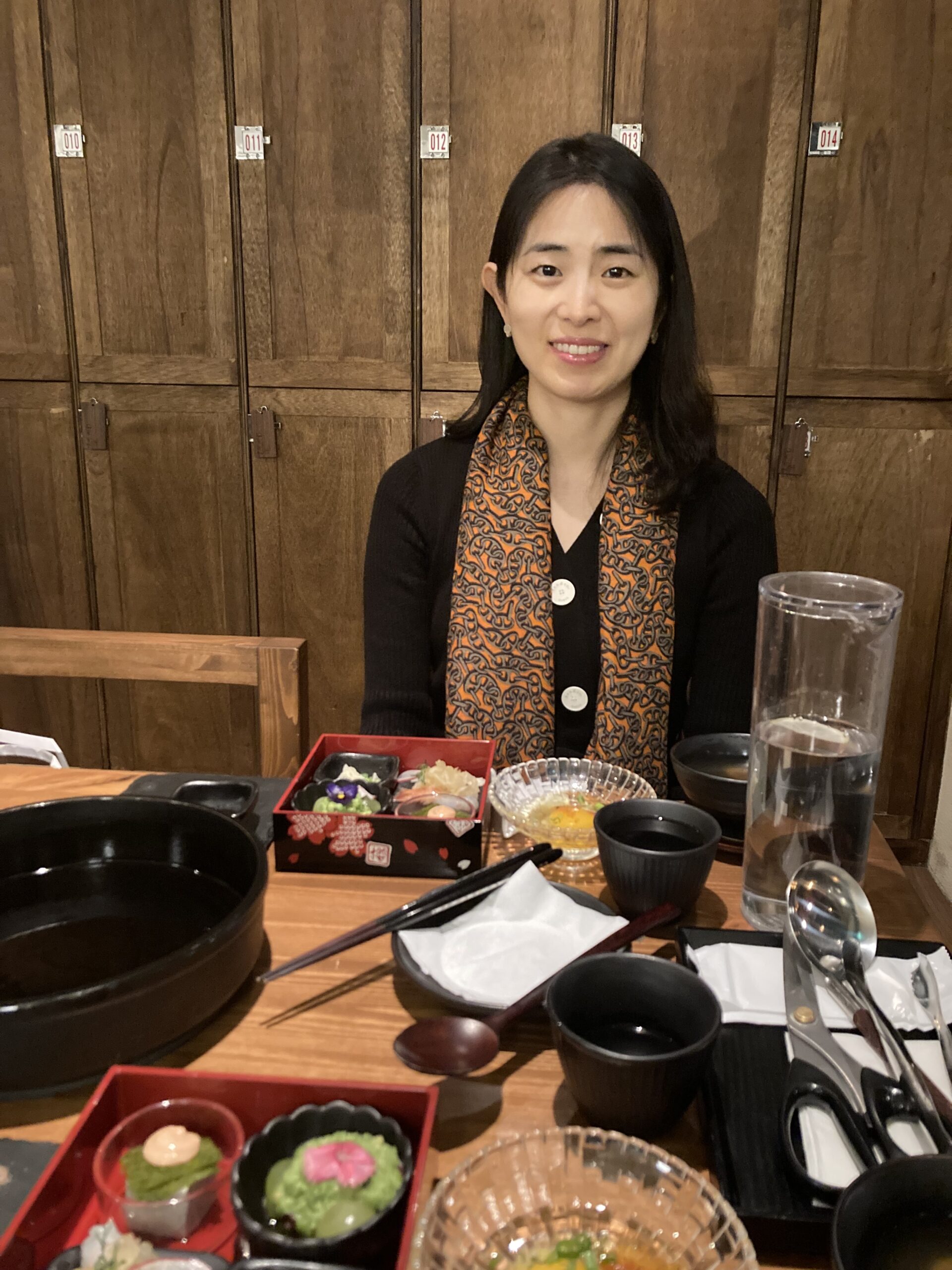
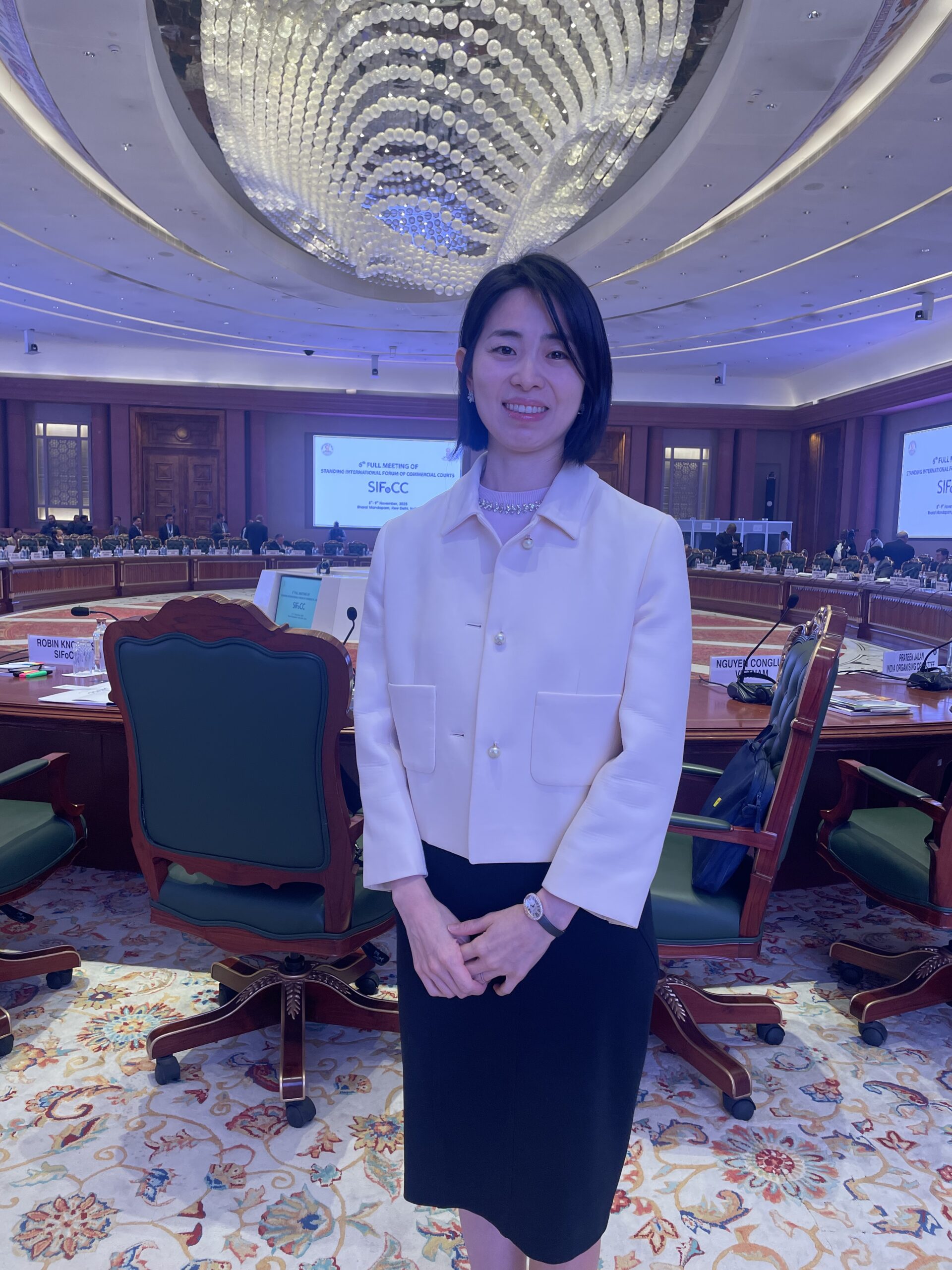
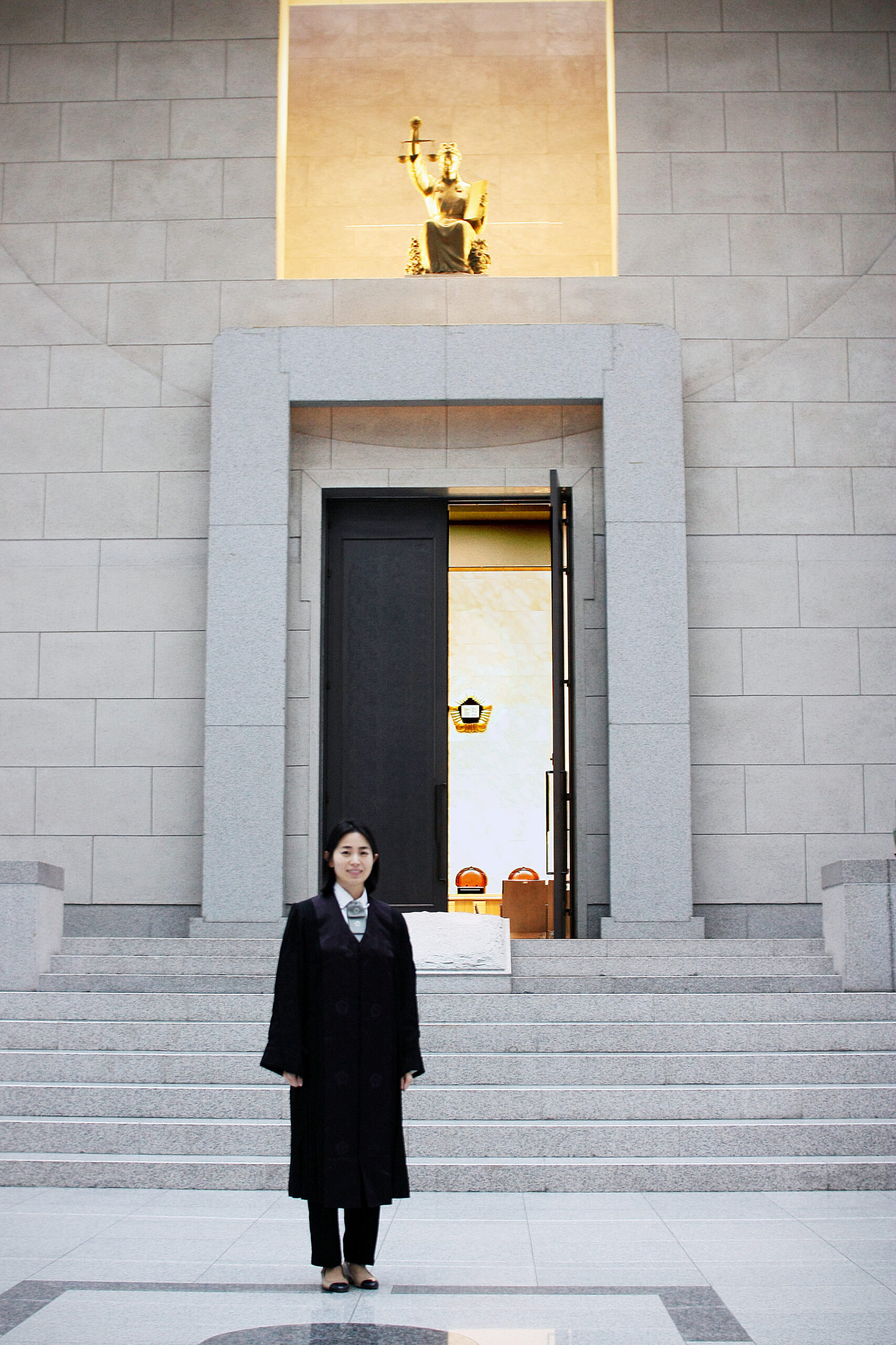
From left to right:
- A more casual photo from a restaurant in Seoul, always enjoy good food and good company!
- Taken at the 6th Full Meeting of the Standing International Forum of Commercial Courts in Delhi, India.
- On her final day as a judge, in front of the Grand Court at the Supreme Court of Korea.