
Maxwell goes green
Reminders to encourage our guests to make sustainable decisions
Motion sensor lights along the corridor at Maxwell Chambers Suites
All rooms in Maxwell Chambers are set to 24 degrees
Textile Donation Drive
Solar Panel Project
Maxwell Goes Green
At Maxwell Chambers, we are committed in embracing sustainable practices. From reducing energy and water consumption to implementing recycling and waste reduction programmes, we are changing our work habits and carefully choosing businesses we want to support and work with.
Maxwell Goes Green is our sustainability programme launched in April 2023. To start our journey, we are assessing our current practices and identifying areas where we can make improvements. By setting goals and tracking our progress, we can stay accountable and identify areas for further improvement.
It takes time to create transformational change but as a company we are ready to take the necessary steps to start.
Maxwell's 5 Actionable Goals in 2026
We are intentionally taking firmer steps to reduce our environmental impact and embed sustainability into everyday decisions.
Intentionally Reduce
Our Energy Consumption
- Purposefully maintain air-conditioning at 25°C in all common areas.
- Clearly communicate temperature settings to staff, tenants and users.
Further Reduce Paper and
Single-Use Materials
- Remove single-print stationery and printed event materials, while encouraging users to reach out if these are required
- Move operations towards paper-light and digital-first processes
Our Commitment to Sustainable Partners & Vendors
- Strengthen sustainability considerations in vendor selection and engagement.
- Continue offering paperless options and opt-in catering counts for all events held at Maxwell Chambers.
Encourage More Sustainable Choices by Our Users
- Strongly encourage users to order responsibly to reduce food waste.
- Use clearer messaging to support informed, sustainable decisions.
- Encourage partners to align with Maxwell Chambers’ sustainability priorities, including a 40% reduction in food orders, to collectively minimise food waste.
- Where appropriate, a food wastage fee may be applied for events held at Maxwell Chambers as part of our efforts to encourage responsible ordering.
Improve Waste Reduction and Resource Efficiency
- Educating, improving and encouraging recycling practices and waste segregation.
- Explore additional ways to reduce waste and increase efficiency across operations.
These goals reflect our intention to move beyond awareness and into consistent, purposeful action — together with our staff, partners and users.
We encourage you to join us in our efforts in creating change towards a more sustainable future. If you have any suggestions or would like to be involved, please email us at [email protected].
Let's talk Sustainability
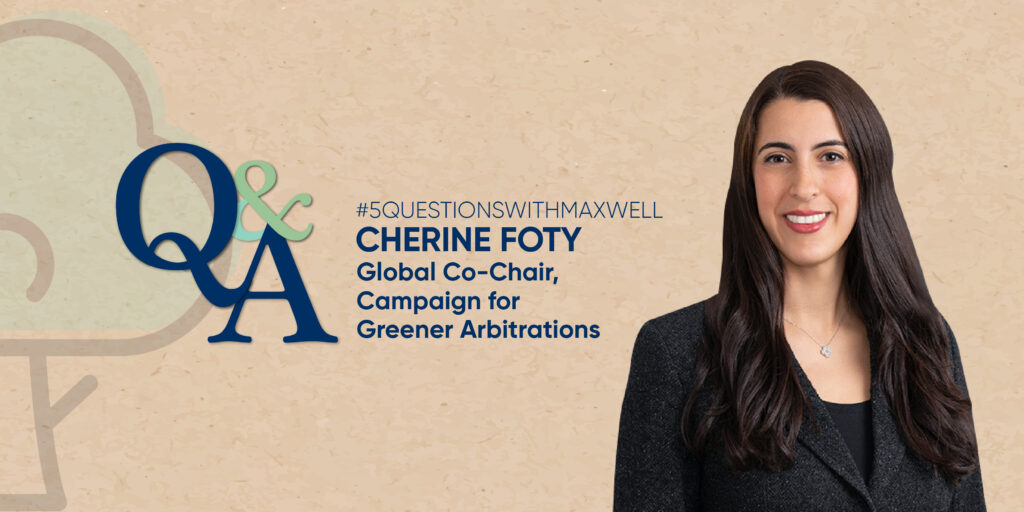
Driving sustainable change, one conversation at a time. In this series, each guest is asked 1 question on making arbitrations greener.
Launched during Singapore Convention Week 2024, “Walk and Talk” featured our first group of #MaxwellCommunity walkers connecting with one another in the beautiful open spaces of Tanjong Pagar.
The Campaign for Greener Arbitrations is an initiative to reduce the environmental impact of international arbitrations. The campaign was founded by International Arbitrator, Lucy Greenwood, in 2019, with the aim of significantly reducing the carbon footprint of the arbitration community. The campaign is made up of a group of arbitration practitioners committed to achieving sustainable change in the way arbitrations are managed. The campaign promotes awareness of the environmental impact of arbitrations and produces best practice guides on ways we all can act to minimise the carbon footprint of our practice.
Campaign for Greener Arbitrations (CGA) Roundtable Session: Carbon Data for Arbitration Institutions: What You Need to Know Before You Measure
📅 𝗗𝗮𝘁𝗲: 30 June 2026 (Tuesday)
🕟 𝗧𝗶𝗺𝗶𝗻𝗴: 4:30 PM – 5:30 PM (HKT/SGT, UTC+8)
💻 𝗙𝗼𝗿𝗺𝗮𝘁: Virtual via Zoom
This interactive discussion will explore:
✔️ The fundamentals of carbon data and carbon accounting
✔️ How emissions are measured and interpreted in practice
✔️ Practical considerations for arbitration institutions
✔️ Approaches to carbon reduction and offsetting
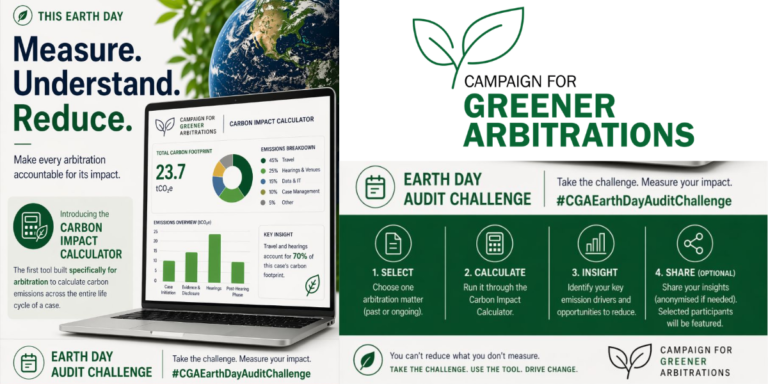
✔️ Insights into the newly launched CGA Carbon Impact Calculator
Campaign for Greener Arbitrations (CGA) launches innovative Carbon Impact Calculator (2026)
To support arbitration practitioners quantify the environmental footprint of arbitrations, the CGA Calculator enables users to identify and quantify carbon emissions across all stages of an arbitration, from initial filing through to final award.
The CGA Calculator focuses on indirect emissions, categorising impacts across two main categories, namely energy consumption and other emissions. The CGA Calculator integrates scientifically grounded assumptions, including around purchased electricity for computer use, printing and emails, as well as travel, hotel stays, computer manufacturing, data storage and material use. The CGA Calculator is developed in accordance with the GHG Protocol Corporate Standard, the leading global standard for carbon accounting.
CGA Second Annual Greener Arbitration Writing Competition (2026)
Maxwell Chambers is a proud promotional partner of the 2026 Greener Arbitration Writing Competition organized by the North America Committee of the Campaign for Greener Arbitrations (CGA-NA) and the Elisabeth Haub School of Law at Pace University (Haub Law).
The competition is for anyone interested in the intersection of arbitration and environmental law. The paper that will be chosen for this award should make a substantial contribution to legal literature and reflect original research and/or major developments in previously reported research. The winning submission will be awarded a US$5,000 prize generously funded by Haub Law and the AAA/ICDR. The deadline for submissions is August 31, 2026.
Report on The Green Survey: Arbitration Institutions in Focus (2024)
In 2024, the Campaign for Greener Arbitrations (CGA) conducted The Green Survey: Arbitration Institutions in Focus to assess how arbitration institutions are adopting sustainable practices. This latest report analyzes successes, challenges, and progress toward environmental goals, offering clear guidance for institutions yet to implement sustainability and practical insights to support those overcoming challenges in advancing green initiatives.