
Interviews
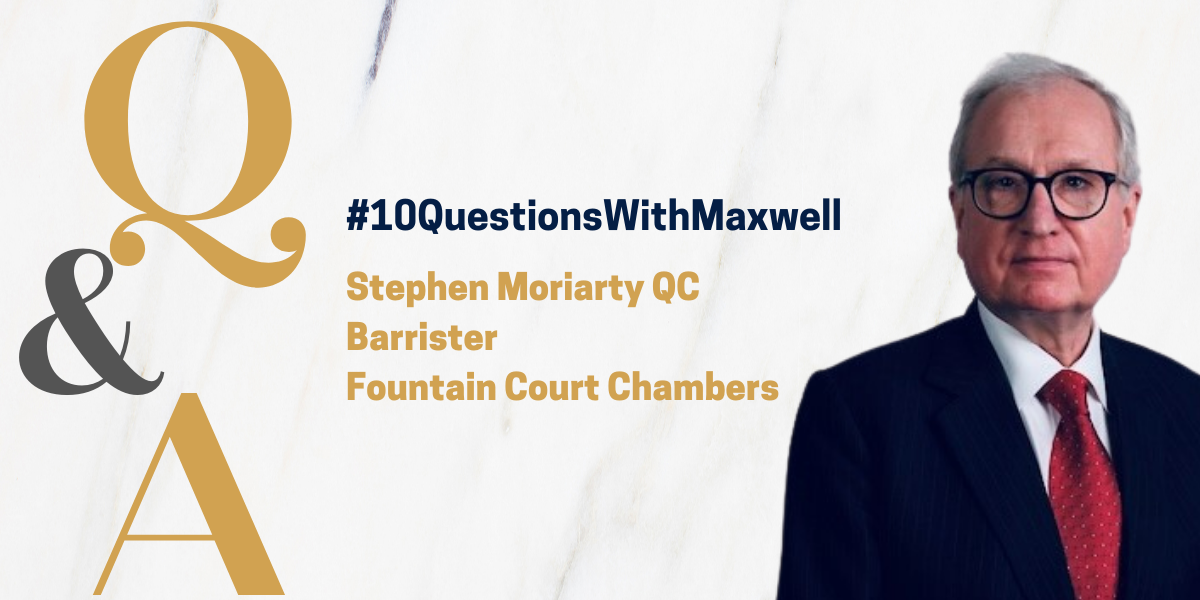
#10QuestionswithMaxwell Interview Series: Stephen Moriarty QC, Fountain Court Chambers
In this #10QuestionsWithMaxwell interview, we feature Stephen Moriarty QC, a barrister at Fountain Court Chambers. He is also a Mentor for the Maxwell Mentorship Programme (Technology in Alternative Dispute Resolution).
Stephen has a very broad commercial litigation, arbitration and advisory practice. He is equally at home undertaking large and complex commercial trials involving heavy amounts of cross-examination or arguing difficult points of law in the appellate courts. He also sits as an arbitrator.
Stephen likes to keep his commercial practice as wide as possible and, particularly given his academic background, especially enjoys cases which involve developing a new area of law from first principles, or by reference to case law in different areas of the law. Areas in which he has had particular expertise over the years are banking and finance disputes, insurance and reinsurance disputes, international arbitrations, professional negligence cases, joint venture disputes and commercial dispute resolution more generally.
The international nature of Stephen’s work means that he frequently deals with issues of private international law, as well as cases where foreign law issues are important aspects of the dispute. Over the years, he has dealt with cases involving questions of US law, Indian law, French law, German law, Italian law, Greek law, Iranian law, Egyptian law, Mexican law, Chinese law and Indonesian law. He has also given expert evidence of English law in a number of foreign proceedings.
After spending seven years teaching a wide range of subjects, both at undergraduate and graduate level, in the law faculty of the University of Oxford, Stephen commenced practise as a barrister in 1987. He was called to the Bar in 1986 and took silk in 1999.
In this interview, he shared how the role of an arbitrator has changed since he started his career, the most memorable dispute he had been a part of, one piece of invaluable advice he would give to the Mentees, and more.
Read his full interview below:
Q: How has the role of an arbitrator changed since you started your career?
A: When I first encountered arbitrations at the start of my career as a legal practitioner, it was in the context of being counsel in a lot of ad hoc insurance and reinsurance arbitrations. In those days, despite being arbitrations, the procedure adopted very much mimicked court practice at the time, so that arbitrators were, on the whole, very “hands-off” in their approach. Nowadays, arbitrators play a much more active role in the management of the arbitral process, and can be very innovative in tailoring case management techniques to the demands of the particular dispute before them.
Q: Even with your extensive experience in arbitration practice, what do you find most challenging being an arbitrator?
A: One thing is definitely having to steel myself to read through pages and pages and pages of Redfern Schedule to resolve disputes over document production. As it happens, I am not as opposed to extensive document production as many other arbitrators are. As counsel, I have experienced enough instances of document requests which I considered justified being refused on the grounds of being too wide, or not sufficiently material to the outcome of the dispute, to deter me starting from the assumption that less is more. But, even so, it is a really hard slog having to read through reams of requests, objections, and responses, and then try to see the wood from the trees before reaching a decision. That is especially the case when one is a sole arbitrator, where there is no-one else to canvass the issues with.
Q: If you could change one thing about the arbitral system, what would it be?
A: In those jurisdictions in which there is no ability to appeal an award on grounds of error of law, I would introduce a right of appeal, albeit a limited one along the lines of that afforded under the English Arbitration Act 1996. I know it is said that one advantage of arbitration is finality, and that those who choose to arbitrate knowingly take the risk of a tribunal getting the law wrong. However, I do not think one can underestimate the resentment felt by a losing party — and the knock-on loss of confidence in the arbitral process as a whole — if a decision is plainly wrong as a matter of law, but there is no available redress. Also, even the possibility of such an appeal would provide an extra incentive to tribunals to go that extra mile to get the law right.
Q: Without sacrificing confidentiality, share with us the most memorable dispute you have been a part of.
A: Probably it is a dispute which remains memorable for reasons having nothing to do with the nature of the dispute itself. I was only in the first month of my pupillage, and my pupil master was acting for the claimant in a shipping arbitration. At the end of the first week, I managed to walk off with a lot of the Presiding Arbitrators papers, because he had a briefcase very similar to my own. He was not best pleased, and I am still thankful that my pupil master won the arbitration, as I fear my faux pas might otherwise have tarnished my application to join Chambers more than it did.
Q: What steps do you think practitioners need to take in order to maintain their profile in the ADR community?
A: Obviously, attending and speaking at conferences is a good way of maintaining a profile as an arbitrator. As in all things, however, I still think the most important thing is to do a good job. If you are really abreast of the detail of a dispute, and give the parties a polite and fair hearing, your reputation will precede you.
Q: You are a Mentor on our Maxwell Mentorship Programme, what is one piece of invaluable advice you would give to our group of Mentees or other younger legal practitioners in entering the alternative dispute resolution field?
A: I would say do not get overly fixated on entering the field of alternative dispute resolution at a very early stage at the expense of getting more general experience of law and legal practice. Acquiring a sound knowledge of basic legal principle, and gaining experience in the conduct and resolution of all manner of disputes, will stand you in good stead in due course.
Q: You have enjoyed an illustrious career. What would you like to achieve that you have not yet accomplished?
A: I genuinely do not have anything in mind. That is not complacency: just a recognition that almost everything which has happened to me in my career is fortunate happenstance, rather than the result of an over-arching life plan.
Q: If you weren’t in your current profession, what profession would you be in?
A: I am going to have to cheat at this one by defining my current profession narrowly as a practising lawyer; and say that, if I was not a practising lawyer, I would be an academic one, as indeed I started out. The truth is that I cannot think of anything else I would be reasonably good at.
Q: How do you like to enjoy your free time?
A: Going to the theatre and opera, and travelling around the Far East (especially when meeting all my good friends in Singapore).
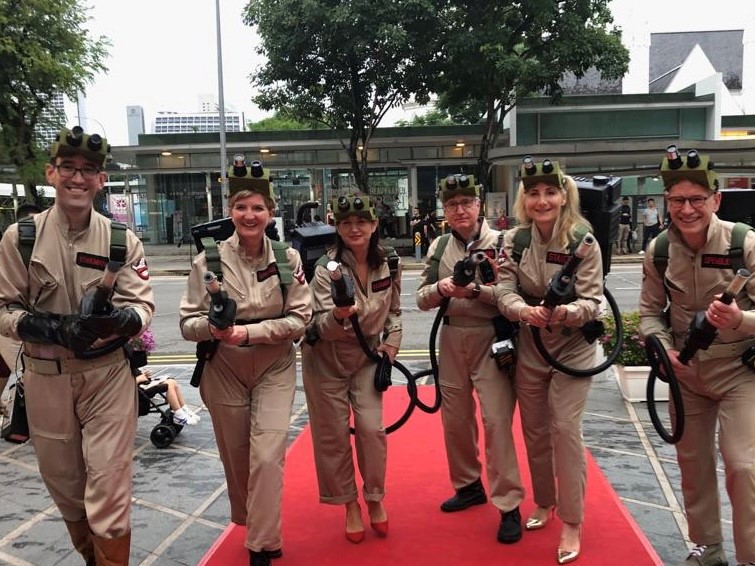

Q: Lastly, share with us your fondest memories of Maxwell Chambers
A: I am not sure what counts as a “fond” memory for this purpose. If it includes experiences which incline one to like someone or something, I would say it is the friendly ambience in Maxwell Chambers, and the sheer quality of the premises and the services provided. “World-beating” is a much over-used term, but I think it can fairly be used in the case of Maxwell Chambers.